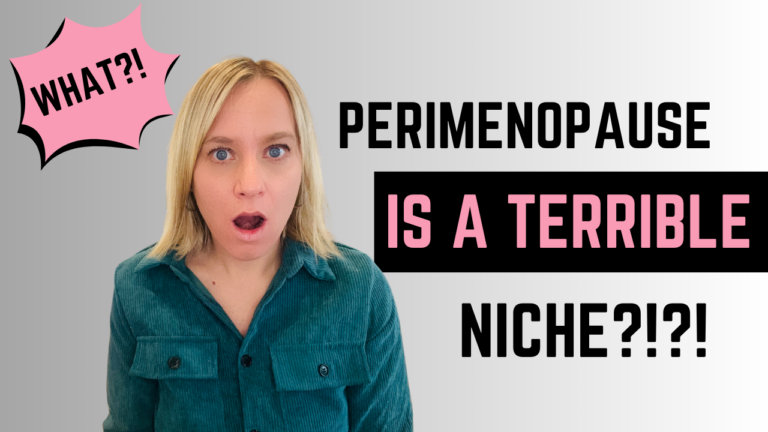
If you’re a health coach or practitioner who has built (or is trying to build) your business around perimenopause, this one might sting a little. But stick with me, because I’m not telling you to burn it all down. I’m telling you why the perimenopause niche, the way most coaches are doing it, is keeping you stuck with a full email list and an empty client roster. And I’m going to show you exactly how to fix it so your marketing actually converts.
I’ve been coaching practitioners and health coaches on their businesses since 2015. I’ve watched niches rise, fall, and rebrand themselves. And right now, perimenopause is the hottest niche walking through my door. Almost every woman coach who joins my program, Health Coach Accelerator, says she wants to do perimenopause. Every. Single. One.
And almost every single one is making the same mistake.
So let’s talk about why the perimenopause niche is a trap, why it’s probably the reason your audience isn’t buying, and what you need to do instead to actually sign clients.
Nobody Can Even Agree on What Perimenopause Is
Before we get into the business side of this, I want you to understand something that most coaches completely overlook: there is no universally agreed-upon definition of perimenopause. And that matters way more than you think.
The World Health Organization defines perimenopause as the period of time immediately before menopause when biological and clinical features of approaching menopause begin, plus the first year after menopause. The Stages of Reproductive Aging Workshop, which is the closest thing we have to a standardized clinical framework, says perimenopause begins when your menstrual cycle starts varying by seven or more days from your own baseline for at least two cycles, and it ends 12 months after your final period. The NIH just calls it “the menopausal transition” and says it usually begins in your 40s but can start earlier and last several years. That’s it. That’s the whole definition.
Then you’ve got the North American Menopause Society saying the transition lasts four to eight years, while the Centre for Menstrual Cycle and Ovulation Research says it’s a six to ten year phase. Most healthcare providers will tell you you’re in perimenopause when your cycles start becoming irregular, which is pretty subjective and varies from doctor to doctor. And the general public? Most people use perimenopause and menopause interchangeably, which doesn’t line up with any of the medical definitions.
An actual NIH-published paper called perimenopause “an ill-defined time period.” A published review of menopause research found that these major organizations have vague starting points and are using overlapping, confusing terminology.
So we’ve got at least five or six different definitions depending on who you ask. It can start anywhere from your mid-30s to your mid-50s. It can last a few months to over a decade. And there’s no reliable hormone test to confirm it because hormone levels fluctuate constantly.
Why This Matters for Your Coaching Business
If the medical community cannot agree on a definition, your audience definitely doesn’t have a shared understanding of what perimenopause means. Some women think they’re in it at 36. Some think it doesn’t start until 50. And you’re trying to speak to all of them, which means you’re probably landing with none of them.
This is problem number one, and most perimenopause coaches have never even considered it.
The Real Problem: Perimenopause Is Not a Niche, It’s a Life Phase
Here’s where we need to get honest. Perimenopause has become a catch-all explanation for basically anything happening to a woman in her 40s. Weight gain, hair loss, acne, mood swings, irregular cycles, gut issues, fatigue, brain fog, anxiety. All of it gets lumped under the perimenopause umbrella.
And sure, perimenopause can cause these symptoms. But just because a woman is experiencing them in her 40s doesn’t necessarily mean perimenopause is the root cause, or that it’s the only thing going on. There could be other contributing factors. A lot of coaches and practitioners blame everything on perimenopause, and it might just be part of the picture, or maybe not the cause at all.
Here’s why this is a massive problem for your business: if perimenopause can cause virtually any symptom, then every single person going through it has a very different experience. And something that makes marketing and messaging effective is sameness. You need to be speaking to a clear human identity with a clear problem where there’s a high degree of overlap. Where if you speak to one ideal client, basically everyone in your audience resonates with what you’re saying.
But when the experience is as wide and varied as perimenopause? The woman who can’t lose belly fat, the woman who is deeply fatigued, the woman having crazy mood swings and anxiety, the woman with debilitating insomnia. These are wildly different lived experiences. They all could be happening during perimenopause, but the day-to-day reality is nothing alike.
Perimenopause Is Not an Identity and It’s Not a Problem
This is the part that trips people up the most. Perimenopause is a life phase. It’s a transition that happens to all women at some point, anywhere from roughly 35 to 55. It is not an identity. It is not a specific problem. And your niche needs both of those things to work.
Even if someone has multiple perimenopause symptoms, they are fixated on the primary one that is ruining their life the most. The woman gaining weight wants the coach who specifically talks about weight gain in your 40s. The woman losing her hair wants the coach who specifically addresses hair loss. When you only say “perimenopause,” you can’t speak to any of them with any real specificity.
One day you post about hair loss, and only a tiny slice of your audience cares because not everyone has that symptom. The next day you post about weight gain, and the hair loss people tune out. Then you’re posting about anxiety, then gut issues, then brain fog. Your content is all over the place, and nobody ever feels like you’re directly talking to them.
What you end up with is a broad, vague audience that never actually feels seen by you.
The Perimenopause Trap: Full Email List, Zero Sales
I’ve been doing this for over 10 years, and nobody was really niching in perimenopause until about three or four years ago. I believe it’s basically “female hormone imbalance” rebranding itself, which was the hot niche when I was starting out. That niche was equally vague, by the way. What does “hormonal imbalance” even mean when there are dozens of hormones in the body? How does someone with no medical background decide they have a hormonal imbalance?
But here’s what’s happened: perimenopause has exploded. It has celebrity attention, mainstream media coverage, and a massive industry has popped up around it. You’re not just competing with other health coaches and practitioners anymore. You’re competing with doctors, naturopaths, influencers, supplement companies, and apps. Everyone is jumping into this space at the exact same time.
This is especially problematic for unlicensed practitioners who can’t prescribe BHRT (bioidentical hormone replacement therapy), which is arguably the hottest thing in the perimenopause world right now. If you can’t prescribe it, you’re at a serious disadvantage competing against licensed professionals who can.
The Trap That Tricks You
There is something happening that makes you feel like you can build a thriving business in this space, but it’s actually tricking you. There is broad interest in perimenopause. Women in their 40s are genuinely curious. They’ve heard about it, they wonder if that’s what’s going on with them, they wonder if that’s why they suddenly gained weight or can’t sleep or feel more anxious than ever.
So they will happily download your freebie. They will respond to your ad. They will follow you, join your email list, open your emails. But your content never specifically speaks to their lived experience because perimenopause is different for everyone.
What you end up with is a list full of interested people who are not buying. They’re engaged, but they don’t convert. Because ultimately, they’re going to hire the coach who speaks to their specific problem with scary precision.
I’ve seen people in the perimenopause space with tens of thousands of people on their email list and not getting sales. Imagine having 15,000 or 20,000 people on your list and still struggling to fill spots in your program. I see this happening in the perimenopause space, and it’s heartbreaking because those coaches have done the hard work of building an audience. The audience just isn’t converting because the messaging is too broad.
The Fix: How to Niche in Perimenopause the Right Way
Obviously women in perimenopause need help. It’s a challenging time, and you have real expertise to offer. So you don’t have to abandon perimenopause. You just need to get specific with it.
Here’s what I have my students do inside HCA: you need to pick a specific problem that perimenopause causes and pair it with a specific female identity.
This is the formula. Specific problem plus specific identity equals a niche that actually converts.
Real Examples That Are Actually Working
Let me give you some examples from my own students so you can see this in action.
One coach helps busy professionals in perimenopause with weight loss. She recently sold five spots at $2,500 in her weight loss program. Another weight loss coach who also targets the perimenopause demographic just sold three spots at $2,000 in a launch. We have coaches working with busy moms dealing with fatigue in their 40s, women in their 40s struggling with anxiety, and so on.
When you target women of a certain age, say women in their 40s (because I think we can all agree that perimenopause is probably happening or starting to happen or on the verge of happening in your 40s), you are naturally going to bring perimenopause people into your audience. You don’t have to use the word “perimenopause” as your niche. Just by the nature of choosing that demographic, you’re attracting the right people.
And here’s the thing: you can still help them with perimenopause inside your program. Even if you market around weight loss or anxiety or insomnia, the women who come to you are going to be dealing with perimenopause. So your program should absolutely include curriculum on perimenopause-specific strategies. You’re just not leading with it in your marketing.
Choosing the Right Identity for Your Perimenopause Niche
Beyond the specific problem, you need to target a specific identity. This is non-negotiable in today’s market. There is so much saturation and competition online, not just in health and wellness but across the entire online business space, that you need to be laser-focused.
Think about the identities a woman in her 40s might hold. She could be an empty nester who had kids in her 20s and is now in her late 40s. She could be a busy professional. A working mom. A stay-at-home mom. A single professional. A newlywed. Each of those identities creates a very different day-to-day experience, and your messaging needs to paint that experience clearly.
Here’s what I mean. Weight gain shows up very differently for a single professional versus a stay-at-home mom. For the single professional, maybe the weight gain is making her not want to date. She feels like she’s going to be alone forever because she has zero confidence to put herself on a dating app or go out. She’s convinced that as soon as someone sees her body, they won’t want to date her. That’s a very specific, very painful experience.
For a stay-at-home mom, the weight gain might be tangled up with something entirely different. Maybe it’s about not feeling attractive for her husband, losing her libido because she doesn’t feel confident in her body.
Same symptom. Completely different emotional experience. And your marketing needs to speak to one of those experiences so clearly that the right person feels like you crawled inside her brain.
How You Market and How You Practice Are Two Different Things
This is a distinction that a lot of coaches miss, and it’s one of the most important things I can tell you. How you market and how you practice are just very different things.
Marketing is about communication. It’s about meeting people where they are, speaking their language, making them feel seen and understood. Practicing is about doing all the things you know how to do to actually help people get results.
So even if you bring someone in for weight loss, you’re probably still going to help them with mood issues, sleep, hormonal regulation, and all the other stuff that comes with perimenopause. Inside your offer, you’re doing the comprehensive work. But your marketing speaks to one person with one problem.
You can absolutely still talk about perimenopause in your content because it is relevant to your audience. You can speak to how perimenopause is driving or worsening their specific problem. You can explain why this issue suddenly showed up in their 40s. You can share perimenopause-related education and insights. But your lead messaging, your core positioning, targets one person with one problem so clearly that she feels like you’re talking directly to her.
Why This Formula Gives You Endless Content Ideas
Here’s what I love most about the Story Imprint Formula: it never runs dry. Because life keeps happening. Every single week, you’re going to have little moments that are slightly out of the ordinary. Funny things your kids say. Awkward interactions. Small adventures that didn’t go as planned. Weird observations. Things that made you laugh or think or shake your head.
And every one of those moments is a potential piece of content. You just need to capture it (hello, story dump note), find a relevant lesson to connect it to, and then write it using the structure I just outlined.
When you start sending out story-based emails and creating this kind of content, I almost guarantee you’re going to get more response. More replies. More engagement. More people telling you that your emails are funny and relatable. And that’s exactly what you’re going for.
Because at the end of the day, humans buy from humans. And when you tell stories, you become more memorable and more unforgettable. People start picturing themselves in your life. They feel like they know you. And that kind of connection is something no amount of educational content can replicate.
You end up with content that feels human, connection-based, and relatable, instead of stuffy, formulaic posts that sound like everybody else’s. And you don’t need to share everything or be an open book. You can be an incredibly private person and still show up online with stories that make people feel something.
Your Perimenopause Niche Action Plan
So here’s your public service announcement: perimenopause as a standalone niche is a trap. But it’s only a trap if you do it the way everyone else is doing it, which is broad, vague, and trying to speak to every woman having every possible symptom.
If you get specific, if you pick one problem and one identity and build your messaging around that combination, you can absolutely build a thriving business helping women navigate this phase of life.
Stop trying to be the perimenopause coach. Start being the coach who helps busy professional women in their 40s lose the stubborn weight that showed up out of nowhere. Or the coach who helps working moms in their 40s get their energy back so they can actually show up for their life. Or the coach who helps single women in their 40s manage the anxiety that’s taken over since they hit midlife.
That’s how you win in this space. That’s how you go from a full email list and zero sales to actually signing clients who are ready to pay.
You don’t have to throw your perimenopause expertise away. You just have to shift how you’re positioning it. And when you do, everything changes.