It’s 2002. Snow is flying sideways, the wind is slapping me across the face, and I’m standing at the top of a half-pipe that looks a hell of a lot bigger from up here. This is the Junior World Championships. It’s televised. There are announcers, a crowd, and some dude with a headset screaming into a walkie-talkie. My skis are clamped on, my stomach is in my shoes, and every muscle in my legs is twitching. My first thought? I fucking hate this.
There were only 12 women in the whole event. Back then, before it was cool and before women were really invited to take up space in this sport, that was a decent turnout. I was the only Canadian, and I was definitely not the best. I had bailed more times than I could count in mogul skiing. I’d placed dead last. I’d been laughed at. But I was decent at big air and half-pipe, so I kept showing up. Embarrassed sometimes, but always determined.
The announcer calls my name. “Three, two, one…” I drop in. Mute grab, Japan air, a 540 at the bottom. And I land it. I fucking land it. I ended up getting third place, the first Canadian woman to ever place in the top three in that event.
But the real reward wasn’t the jade grizzly bear award the government sent me (though it is cool). The real reward was proving to myself that I could be scared and show up anyway. That I could look like a fool for a while and still come out with something that mattered.
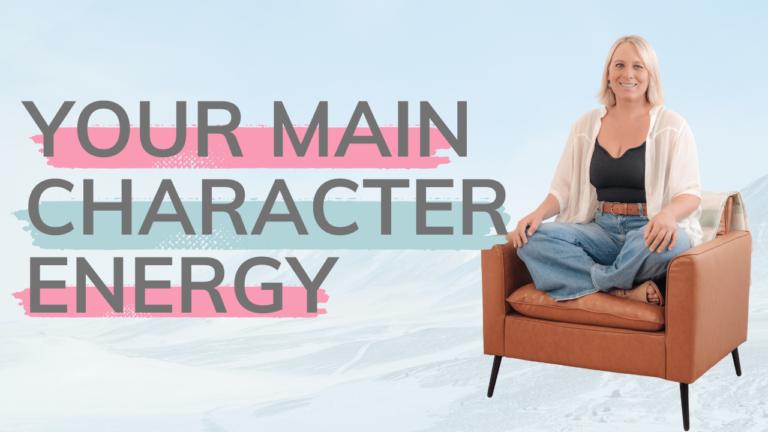
This right here? This is what main character energy looks like.
It’s not about being the best or being perfect. It’s not about waiting until your business is polished, your bio is perfect, and your branding feels aligned. Main character energy is putting yourself out there while you’re sweating, low-key panicking, and secretly wondering if you’re about to crash and burn. And then doing it anyway.
In 2026, this is how I want you to show up. Staying safe and hiding feels better in the short term, but you don’t build a six-figure business from the sidelines. You build it by getting your ass in the game, knowing you might land the 540 or you might totally face-plant. This is how you set yourself up to win.
What is Main Character Energy? (Hint: It’s Not Narcissism)
Let’s get one thing straight: main character energy isn’t about being a narcissist. It’s about ownership. It’s about recognizing that you can’t build a legacy while acting like a side character in your own business. If your business is a movie, are you the lead, or are you the barista who shows up for two minutes in Act 2?
Embracing this energy means taking bold action—action that scares you, but that you commit to doing anyway. Businesses are not built in comfort zones. Think about it. You’ve already done scary things. You went to college, had a baby, got married, all without knowing the outcome. We show up with main character energy in so many parts of our lives, but when it comes to our business, we shrink.
I don’t want you to be one of those people who comes to me in five years saying, “I’ve been doing this for five years and I’ve only had three clients.” I want you to succeed. But success means doing hard things.
So, what are the three boldest actions you’re afraid to take right now?
- Is it doing an Instagram Live?
- Is it putting your face on social media?
- Is it hitting “publish” on a Facebook ad?
Whatever it is, I want you to commit to doing it. The more you hide, the more time you’re wasting. Let’s talk about the actions you can take to finally step into the lead role of your business.
1. Plan Your Year and Set Tangible Goals
I’ve never been a planner. I’m a rebel to a fault, always wanting to fly by the seat of my pants. That worked for a while, until it didn’t. In early 2020, I way over-scheduled myself. I planned multiple launches, signed up for a live event, got roped into hosting another live event, and had a wedding to attend. I was struggling with my energy, and I remember feeling so completely overwhelmed by my own schedule.
Then, COVID happened. All my live events and travel plans were wiped clean off the calendar. As much of a nightmare as that time was for the world, it was a wake-up call for me. It made me realize I was letting my schedule take me on a fucked-up ride.
Running your business without a plan is like driving across the country with no GPS and just hoping you’ll magically end up in Las Vegas. You need a map.
Annual, Quarterly, Monthly, Weekly Planning
Planning isn’t about creating a rigid, unchangeable schedule. It’s a flexible framework. Here’s how I approach it:
- Annual Planning: I start by blocking out all my vacations and personal trips for the year. For example, I know I’m going to Spain for almost a month in May. That means no launches, no live trainings, and a lot of prep work beforehand. My personal life goes on the calendar first. Then, I map out my promotional calendar, like my monthly live trainings.
- Quarterly Planning: Each quarter, I reassess my plan. Does it still make sense? Do I need to move some dates? This helps me stay agile without feeling overwhelmed.
- Monthly & Weekly Planning: Each month and week, I get more granular. I time-block my calendar so that when I sit down at my computer, I know exactly what I’m working on. Today, I knew I was recording podcast episodes. I didn’t waste an hour scrolling through Canva trying to figure out what to do. Your time is valuable—treat it that way.
Work Backward from Your Goals
A plan is useless without a destination. What’s your revenue goal for 2026? How many clients do you want to sign each month? Once you have that number, you can work backward to figure out how to get there.
Hoping, praying, and manifesting isn’t a strategy. Let’s say you want five clients a month but have no budget for ads. Maybe your strategy is DM outreach. Starting conversations in DMs still works. If you know that you convert 1-2% of those conversations, you can calculate how many you need to start each month to hit your goal.
From there, you plan the execution. What will you say? How will you follow up? Will you sell in the DMs or get them on a call? This is how you create a tangible plan.
Use the “Good, Better, Best” Goal-Setting Method
What happens if you don’t hit your goal? That’s okay. I believe goals aren’t always meant to be achieved; they’re meant to train your brain on what’s possible.
When I do a launch, I track my analytics and know my average conversion rates. But I still set three tiers of goals:
- Good: This is my minimum, based on my lowest-ever conversion rate. It’s a number I’m very likely to hit, which is great for my mindset.
- Better: This is a stretch, usually based on my mid-to-high conversion rates.
- Best: This is my aspirational goal, something a little out of the realm of normal. I’ve actually never hit my “best” goal.
But setting that big, aspirational goal trains my brain to think bigger. It expands my idea of what’s possible.
2. Master Your Messaging
When I started my business, the online world was a different place. There was less competition, and honestly, I was able to do pretty well with really bad content. If I looked at my old content now, I’d give it a D. But these days, with so much noise online, bad messaging is like putting gourmet food in a Tupperware container with no label. No one is going to open it.
You have to be way more specific with your marketing. Saying “I help women with acne feel more confident” is too general. It won’t cut through the noise.
Go Visceral, Not Viral
You need to “twist the knife.” I don’t love that name, but it perfectly describes what you need to do. You have to dig into the pain points and speak to the lived experience of your ideal client. Your goal isn’t to go viral; it’s to go visceral. You want to make them feel like you’re inside their head.
How do you do that? By getting specific. Instead of the generic acne line, try something like this:
“You’re 30, and you’re still dodging mirrors. Your skin hurts, your confidence is tanked, and you’re tired of spending $400 at Sephora hoping this serum will finally be the one.”
See the difference? We’re talking about the specific, day-to-day reality of the problem. How does their acne actually show up in their life?
Think about that moment you wake up, forget about your acne for a second, then walk into the bathroom, flick on the light, and—fuck—there it is. Red, inflamed, and it instantly ruins your day. You spend an hour trying to cover it up with makeup that just clumps and makes it look worse. You spend the rest of the day avoiding bright lights and feeling like a piece of shit.
That is visceral. It speaks to the micro-moments, the thoughts and feelings that no one else understands. Audit your last three posts, your Instagram bio, and your sales page. Is your messaging visceral? Or is it just a plain, unlabeled Tupperware container?
3. Accept That You’re an Online Marketer
I was having a DM conversation with someone the other day who told me she struggles with marketing because she “wasn’t born with the marketing gene.” Babe, there is no marketing gene. Nobody is born with it.
Marketing is a learned skill. I came from a forestry background. I had no ability to market. I had to learn it, and for a long time, I was terrible at it. But I committed to learning.
Resisting this part of your job is just going to keep you broke and confused. Saying “I hate marketing” as an online business owner is like a chef saying, “I love cooking, but I refuse to touch a knife.” It’s a wild statement.
Maybe reframe it. Instead of “I hate marketing,” try “I don’t know how to market yet, but I’m learning.”
Marketing isn’t about being slimy or unethical. It’s about communication. It’s about getting in front of the right people and connecting with them. And if you can’t market, you can’t sell, and you can’t help people. So reframe marketing as connection. It’s a skill, and just like any skill, it takes time. I spent three years learning to mountain bike, crying behind trees and wanting to give up. The fun-to-fear ratio was not in my favor. But I kept going, and eventually, the fun outweighed the fear. It will be the same with your business.
4. Leverage Artificial Intelligence (AI)
AI is my ride-or-die assistant. If ChatGPT went down tomorrow, I don’t know what I’d do. It has made my life so much easier and helped me avoid burnout.
As a coach, my most creative energy needs to go toward supporting my students. In the past, if I was tired from being up all night with a sick toddler, rewriting a student’s sales page felt impossible. Now, I have an AI copywriter that I’ve trained to help me give feedback and rewrite their content. And it rewrites better than I ever could on my own when I’m exhausted.
But here’s the key: you can’t just outsource everything to ChatGPT. You can spot unedited AI copy from a mile away. You still need to know what good copy looks like. You need to train your AI.
I help my students create custom GPTs trained specifically on their target audience, voice, and offer. It’s a game-changer. So many people say, “I don’t know what content to create.” AI can help with that. “I don’t know how to write my content.” AI can help with that, too. I’ve probably saved 15 hours a month in my business because of AI.
Resisting AI is like saying, “I’m just going to continue to ride my horse instead of driving a car.” Sure, the horse will get you there eventually, but it’s going to take a hundred times longer. You will fall behind if you don’t leverage AI.
5. Invest in Paid Advertising
For years, I prided myself on teaching organic marketing because that’s how I grew my business. I dabbled in ads, but they were never the main event. But over the past several years, I watched my students grind harder and harder for fewer results. The algorithms changed, it got more competitive, and the bar for content went way up. I couldn’t ignore it anymore.
Organic marketing is great for depth, showcasing your personality, and positioning yourself as an authority. But for the most part, it won’t get you volume. Paid advertising gets you volume. The combination is where the magic happens.
Running a business without ads is like whispering in a crowded stadium and hoping someone in the back hears you. They won’t.
With a small budget of just $5-$10 a day, many of our students are building their email lists and bringing in new leads every single day. It’s also a huge confidence boost. When you see new people subscribing to your list, you realize that people are actually interested in what you do. It helps you get off the sidelines and step into that main character energy.
Your Boss Era Starts Now
2026 doesn’t owe you anything. But it can be your highest revenue year yet if you treat it like your boss era. You have to take messy action. You have to plan, set goals, and invest in your skills and your business.
Stop grinding on Instagram. Stop whispering into the void. It’s time to take up space, make some noise, and finally step into the leading role you were always meant to play.