As we wrap up 2025, I’m in that strange, suspended space December always brings — where time feels slower and faster all at once. The launch calendar has quieted down. My inbox is less loud. And instead of thinking in deadlines and deliverables, my brain starts drifting into big-picture mode. The kind of reflection that doesn’t happen during the rush of mid-year, when everything’s moving at warp speed and there’s barely time to breathe, let alone zoom out.
It’s the season where I crack open a fresh notebook, pour a hot drink I might actually finish while it’s still warm, and look back at everything the past year has stirred up — in my life, in my business, and in the coaching industry as a whole.
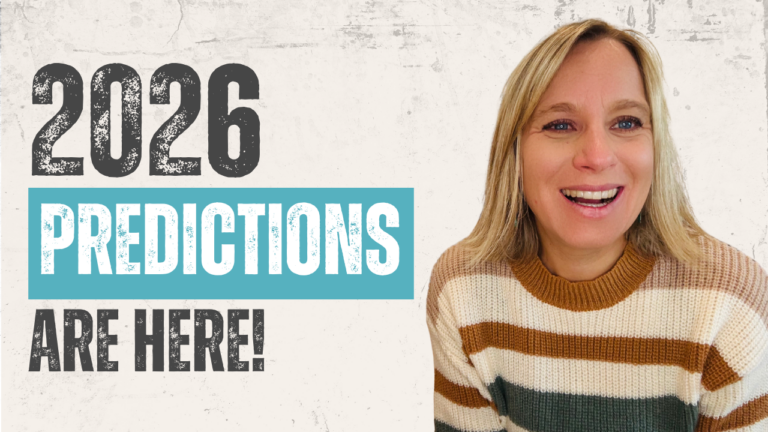
Every December, I pull out my metaphorical wizard hat and do what I’ve always done: stare into the foggy edges of the future and try to name what’s coming. Sometimes I’m spot-on. Sometimes I’m off. But every prediction is rooted in what I’m seeing right now — the conversations I’m having with coaches inside HCA, the shifts I’m feeling in buyer behavior, the patterns that keep repeating across launches, sales cycles, and client results.
And this year? The energy feels different.
Not in a subtle way. In a jarring, unmistakable way.
The pace of change has accelerated so fast, it’s like the ground beneath us is constantly shifting. The tools we used to trust — social platforms, email open rates, ad strategies — all feel a little less steady. AI is evolving by the week. What worked in January often feels irrelevant by July. And the strategies that once felt foundational now seem like they’re being held together with duct tape and good intentions.
But here’s the thing: inside the chaos, there’s also clarity. If you’re willing to look past the noise, there are clear signals. Quiet patterns. Invitations to do things differently.
The predictions I’m sharing with you aren’t just pulled from trends reports or marketing podcasts. They come from the real work — inside my business, inside my programs, and inside the lived experience of navigating yet another beautiful, exhausting, transformational year as a mentor, marketer, and human being who still cares deeply about doing good work in this space.
So if you’re ready to stop spinning and start seeing the map… let’s dive into what I believe 2026 has in store.

1. AI Will Be Everywhere—But It Won’t Replace You
Artificial Intelligence has officially moved out of the “nice to have” corner and is now sitting smack dab in the middle of most coaches’ workflows. It’s no longer something reserved for tech bros in Silicon Valley or high-level marketers with massive teams. It’s in your Canva, in your Google Docs, in your scheduling tools, in your inbox. New tools are launching every week. Platforms are layering in automations, auto-responses, and smart predictions. Everyone is trying to figure out how to do more, faster—and AI is the shiny shortcut.
And to be fair, a lot of it works. These tools really can speed things up. They can write Instagram captions, summarize transcripts, suggest subject lines, and spit out SEO-friendly blog outlines in seconds. Some of them can build sales funnels or design presentations with a few quick prompts. AI is becoming a powerful co-pilot for coaches—helping sort through ideas, clean up messy copy, and organize content with an efficiency that would’ve taken hours (or days) before.
But here’s where we need to slow down and ask a better question: just because AI can do something… should it? Because while it can mimic tone, rewrite your sales page, or generate an entire onboarding sequence, it doesn’t actually understand the people you serve.
It doesn’t know what your client’s voice sounds like when they’re quietly breaking down during a coaching session. It can’t feel the shift in energy when someone shares something vulnerable. It can’t build the trust that’s required to get someone to take real, lasting action.
Sure, a bot can pull together a hormone-balancing protocol. It can probably even list out common triggers for IBS or suggest a morning routine to help with fatigue. But what it can’t do is hold space for the mom of three who hasn’t slept in weeks and feels like her body is betraying her. It can’t walk beside someone who feels like they’ve tried everything and still feels stuck. It can’t deliver hard truths with compassion. And it certainly can’t read the subtext underneath someone’s words the way a seasoned coach can.
Coaching is not just about information delivery. If it were, we could all Google our way to healing. Coaching is about transformation—and transformation requires presence, empathy, intuition, and nuance. These are things AI can’t replicate, no matter how well it’s trained.
That said, ignoring AI would be a huge mistake. It’s not going anywhere. And the coaches who stubbornly refuse to engage with it risk falling behind—not because they’re less talented, but because they’ll be wasting time on things that could be done faster and more efficiently. In 2026, the real opportunity isn’t in fighting the tech. It’s in partnering with it.
Use AI to spark creative ideas when you’re stuck staring at a blank screen. Let it organize your messy brainstorm notes into something usable. Use it to draft the rough version of your email so you can get out of your head and into your zone of genius. Use it to pull insights from client data, batch content, or prep materials for your group calls.
But don’t let it become your voice. Don’t outsource the soul of your business to a tool.
The coaches who thrive in 2026 will be the ones who use AI to work smarter, not colder. Let the machines handle the mechanical tasks. And let you—your stories, your intuition, your presence—remain at the heart of the work.
Let AI amplify you—not replace you.

2. High-Touch Programs Are Not Optional Anymore
Remember the good ol’ days when you could whip up a $197 self-paced course, upload three modules to Teachable, toss in a vague promise about transformation, and slap a link in your Instagram bio? Maybe throw in a Facebook group that no one actually uses except to say “Hi” on Day 1? Back then, that kind of offer sold. People were excited to invest, motivated to learn, and believed that access to information was all they needed.
But the coaching space has evolved. Buyers are no longer wide-eyed. They’ve bought the courses. They’ve binge-watched the trainings. Their Google Drive is a graveyard of PDFs and templates. And yet, they’re still stuck.
Why? Because information alone isn’t enough anymore. In 2025, we watched a noticeable shift in buyer behavior. People no longer want more content—they want contact. They want someone to walk beside them. To witness them. To hold them accountable and help them move through the resistance that’s been keeping them stuck for years.
Inside Health Coach Accelerator, we felt this shift like a tidal wave. Our original model leaned hard on plug-and-play tools. Templates, swipe copy, sales page blueprints—you name it. They were incredibly useful. They gave students a head start. But something started happening. Our students began asking sharper questions. They didn’t just want a checklist. They wanted context. They wanted to know why something wasn’t working. They needed a second pair of eyes on their funnel, their offer, their emails. They needed real-time, situational support.
We couldn’t ignore it.
So we evolved. We began adding high-touch components that gave students more direct access to our brains and our feedback. We offered custom audits of their sales pages. We reviewed their messaging. We helped them refine their positioning—not in some future Q&A session two weeks from now, but in the moment, when they needed it most.
We layered in live support calls with actual coaching, not just lectures. We created systems that allowed us to respond quickly to questions, to troubleshoot problems as they came up, and to guide people based on where they actually were—not where we assumed they were.
And the difference? Massive.
We watched students who had been spinning their wheels for months finally take action. Offers got cleaned up. Messaging started landing. Clients began signing. And perhaps most importantly—they stopped second-guessing themselves. The support gave them clarity. And clarity created momentum.
2026 is going to reward the coaches who stop hiding behind passive delivery and start stepping into a more relational model. No, that doesn’t mean you have to offer unlimited 1:1 calls. But it does mean you need to think deeply about how your program actually supports a human being moving through fear, doubt, and decision fatigue.
It means shorter feedback loops. More personalized touchpoints. And building a container where people feel held, not just enrolled.
Whether it’s through hybrid coaching models, live calls, private feedback, or structured accountability—your clients don’t just want information. They want to feel like someone is in their corner.
That’s the difference between a course that collects digital dust and a program that changes someone’s life.
And the coaches who get that? They’ll be the ones leading in 2026.
3. Low-Ticket Isn’t Dead—But It’s Not a Money Maker Anymore
Let’s be honest—low-ticket offers were once pitched as the golden goose of passive income. Create a $37 resource, slap it on a landing page, run a couple of ads, and boom—money in your sleep. For a while, that worked. But the landscape has shifted. Ad costs are climbing. Attention spans are shrinking. And buyers are more skeptical than ever.
These days, it’s harder to make low-ticket offers profitable straight out the gate. The days of plugging a $47 ebook into a cold funnel and watching Stripe light up are over. And if you’re trying to use that kind of offer to drive consistent, scalable income? You’re going to be disappointed.
But that doesn’t mean low-ticket is useless. Far from it.
In fact, when used strategically, low-ticket offers can be one of the most powerful tools in your funnel—just not in the way most people are still trying to use them.
Inside my own business, I treat low-ticket offers like a front door—not a revenue stream. I build them to warm people up, to qualify leads, and to kickstart trust at a deeper level than a free lead magnet ever could.
Take my $99 Funnel Workshop, for example. It’s designed to solve a specific, painful problem: “Why isn’t my funnel working?” In that workshop, I walk people through the most common funnel mistakes, show them what to fix, and give them a clear path forward. It’s packed with value. It’s actionable. But more importantly—it’s designed to move people into the next step of working with me.
On the back end of that offer, I’ve built a strategically crafted nurture sequence. It’s not just, “Here’s your download, good luck.” It’s a layered, intentional follow-up that introduces them to my approach, shares relevant content, invites them to watch a deeper training, and eventually positions HCA as the natural next step.
I don’t make my money off the $99. I make my money off the people who go through that workshop and say, “Holy shit, if this is what I got for under a hundred bucks, what must her full program be like?”
And here’s the best part: that $99 offer isn’t just building my list. It’s building belief. It’s helping people experience a quick win. It’s showing them that I know what I’m doing. And that trust pays off when it’s time to make a bigger investment.
In 2026, the most effective coaches will stop obsessing over converting cold traffic into cold hard cash. Instead, they’ll use low-ticket offers to create a high-intent audience—people who are engaged, primed, and eager to go deeper.
Think of it like a test drive. A well-built, low-ticket product gives your audience a real sense of what it’s like to work with you. It should be specific, outcome-oriented, and immediately useful. This isn’t the place for vague promises or bloated theory. It’s the place for “Here’s how to fix this exact thing that’s driving you nuts.”
But the magic isn’t just in what you sell—it’s in what happens after the sale. That means:
- Tight follow-up emails that don’t just sell, but connect
- Smart retargeting to keep your name in their feed
- Invitations to go deeper with you—through a sales call, a webinar, or a next-step offer
Low-ticket doesn’t have to be a dead-end. But it also doesn’t have to carry the full weight of your revenue goals. Use it to start the relationship. Use it to show what you’re capable of. Use it to build momentum.
And most importantly—make sure it’s not a standalone island. If your low-ticket offer doesn’t lead anywhere, it’s just a vanity metric. But if it’s designed as a bridge to your high-touch program? It can become one of the smartest pieces of your marketing ecosystem.
So keep your low-ticket offers. But treat them like your first impression—not your final sale. Let them do the job they’re best at: building trust, creating belief, and paving the way for something bigger.
4. Omnipresence Is the New Consistency
Let’s talk about a word that used to rule the online business space: consistency.
For years, the advice was simple—just be consistent. Show up three times a week. Send your newsletter on Thursdays. Publish your podcast every Monday. Stick to the schedule, and eventually, your audience will grow, your brand will build, and the sales will come.
But in 2026? Consistency on its own isn’t enough.
We’re living in a world where your audience is bombarded with content every time they open an app. They’re following dozens, maybe hundreds of coaches, creators, and experts. Their inbox is full. Their feed is endless. And their brain is fried. In that sea of digital noise, being consistent might keep you present—but it won’t make you memorable.
What actually works now is omnipresence. And no, that doesn’t mean being glued to your phone or posting 24/7 like your business depends on it. It means creating the feeling that you’re everywhere at once—without burning yourself out.
Omnipresence is when someone opens Instagram and sees your Reel. Later, they check their email and your name is in their inbox. Then they’re on YouTube and your ad pops up before their video plays. They go to listen to a podcast and hear your voice. It’s not accidental. It’s intentional. And it’s powerful.
Because when someone starts seeing you in multiple places, you move from being just another coach on the internet to someone who feels established, trustworthy, and top of mind.
Inside HCA, omnipresence is part of our actual marketing rhythm. We teach our students how to build campaigns that don’t just rely on one channel. We don’t just “post and hope.” We build content with repurposing in mind. One long-form video becomes an Instagram Reel, a podcast snippet, an email story, and a carousel post. One blog post becomes five pieces of micro-content and a week’s worth of story slides.
And we don’t stop there—we use paid ads to amplify the reach. We teach retargeting so your warm audience keeps seeing your face without needing to scroll for it. We show our students how to use scheduling tools to make their content stretch across platforms without starting from scratch every time.
The result? Our students are showing up in their audience’s world over and over again—without burning out or becoming full-time content creators.
Here’s the thing: omnipresence doesn’t require more effort. It requires more intention. You can create less content and have more impact if you know how to stretch, repurpose, and amplify the assets you already have.
The coaches who win in 2026 won’t be the ones glued to their screens. They’ll be the ones who know how to make one piece of content work ten times harder. They’ll be the ones who show up in a way that feels natural, grounded, and unmistakably present.
Because when your people are finally ready to buy, you don’t want them to think, “Who was that coach again?”
You want them to think, “Oh yeah—it’s gotta be you.”
5. Being an Influencer (Sort Of) Is Now Part of the Job
I know. This one makes a lot of people want to log off and run into the woods.
You didn’t become a health coach to make Reels. You didn’t dream of crafting carousels or vlogging your grocery haul. You didn’t sign up to be a full-time content creator. And the idea of showing your face every day online just to maybe attract a client? Exhausting.
But here’s the thing: the definition of what it means to be a coach is evolving. And whether we like it or not, the lines between coach, creator, and personal brand are blurring fast.
In 2026, today’s buyer isn’t just looking for information—they’re looking for connection. They’re looking for a coach who doesn’t just have the knowledge, but also feels real. Relatable. Human. Because let’s face it, the internet is overflowing with people who claim to have the answers. But what makes someone stand out now isn’t just what they teach—it’s who they are while they’re teaching it.
That doesn’t mean you need to overshare. You don’t have to cry on camera or spill your deepest secrets to build trust. But it does mean you need to stop hiding behind your graphics and stock photos. You need to show your face. Share your voice. Let people in, even just a little.
Inside HCA, we see this shift every day. Students who were hesitant to show up online are now getting the most engagement when they post something personal—like the messy back end of their business, a story about a bad client experience, or the honest truth about how hard it is to juggle motherhood and marketing.
It’s not about being perfect. It’s about being visible in a way that feels like you.
Maybe it’s a behind-the-scenes video of you prepping for a client call. Or a snapshot of your laptop and toddler sharing the same desk space. Or a quick story about the time your funnel completely broke and you had to sell your program live on Stories with no slides and a dying laptop.
These aren’t just random moments. They’re emotional anchors. They help your audience see themselves in you. And when people feel like they know you, they’re far more likely to trust you with their money, their health, and their growth.
Here’s another way to look at it: You’re not becoming an influencer. You’re becoming influential. And there’s a big difference.
Influencers chase virality. Influential coaches build connection.
You don’t need 10,000 followers. You need the right 100 who feel like, “She gets me.”
You don’t need to post five times a day. But you do need to post things that show who you are—not just what you sell.
That might mean:
- Letting people into your world, even if just in small ways
- Sharing stories that show the why behind what you teach
- Showing your personality, your quirks, your real life
Because the truth is, people don’t just buy offers anymore. They buy relationships. They buy based on how safe, seen, and supported they feel by you.
So yes, this is the part where you might need to lean into a bit of visibility that makes you uncomfortable. But you get to decide what that looks like. It doesn’t have to be cringey. It doesn’t have to be performative.
It just has to be you—visible, present, and willing to share just enough to make someone feel a little less alone.
Because in 2026, the coaches who win aren’t the ones with the most polished branding or the biggest team. They’re the ones who make their audience feel like they’re already part of something just by following along.
And the only way to do that… is to show up and let them in.
6. You Need a Signature Method (No More 12-Module Random Courses)
Let’s get real—if your program still looks like a digital university course catalog, filled with 12 modules, 47 lessons, and a Google Drive folder so big it needs its own search bar, it’s time for a serious update.
We’re past the point where more equals better. In fact, more almost always equals “too much.” The average buyer is tired. They’re juggling too many tabs—mentally, emotionally, and literally. They don’t want to scroll through a bloated curriculum to figure out what’s relevant. They want to log in, know exactly what to do, and feel like they can actually do it.
That’s why having a signature method is no longer optional—it’s critical.
A clear, structured, easy-to-understand framework isn’t just a nice branding tool. It’s what helps your client breathe a sigh of relief the second they land on your sales page. It tells them, “This isn’t chaos. There’s a system here. There’s a plan. I’m not going to drown.”
Inside Health Coach Accelerator, we’ve built an entire track dedicated to helping our students extract, define, and refine their own signature method. Not just because it sounds good in marketing—but because it becomes the backbone of their business.
Your method is your client’s roadmap. It’s the thing that gives them momentum before they even enroll. It shows them there’s a real arc to your program—a journey they can actually finish.
Let’s say your coaching method has five steps. Right away, that tells your audience, “There’s a beginning, middle, and end.” It sets clear expectations. It builds belief. It gives them language to understand what’s coming next—which is everything when you’re selling transformation in a world full of overwhelm.
And here’s the kicker: a signature method isn’t just about helping your clients. It helps you too.
It simplifies your content creation. It clarifies your messaging. It organizes your marketing. It gives structure to your live calls, your emails, your launch runway. It becomes a repeatable system you can scale.
Instead of reinventing the wheel every time you go to sell your offer, you now have an anchor—a visual, tangible process that people can see themselves inside.
No more vague promises. No more guessing games. Just a clear, step-by-step path that makes the transformation feel possible.
You don’t need another module. You don’t need more content. You need a method that makes your people think, “This is exactly what I’ve been looking for.”
And no, your method doesn’t have to be wildly complex. In fact, the simpler, the better. Most of the coaches we work with start with a messy brain-dump of everything they do for clients. From there, we help them distill that into 3 to 7 clear phases.
That simplicity becomes power. It makes their work repeatable. It makes their offers scalable. And most importantly—it makes the buyer feel confident in saying yes.
Because when someone’s drowning in decision fatigue, what they don’t want is another promise of “everything you need” jammed into an endless course portal. They want a short, sturdy bridge from where they are to where they want to be.
Your signature method is that bridge. And in 2026, if you want to sell with clarity, deliver with confidence, and build a brand that stands out—you need one.
Ditch the content clutter. Focus on transformation, not information. And show your audience that what they want isn’t out of reach—it’s right there, step by step.
7. Micro-Moment Messaging Will Be Your Secret Weapon
Let’s be honest: people are numb to big, fluffy promises.
The internet is full of coaches shouting, “Live your best life!” “Feel empowered!” “Step into your highest self!” These vague, lofty claims used to work. But in 2026, they’re starting to sound like static.
Because when your ideal client is sitting in their car after work, exhausted and questioning everything, they’re not thinking, “I need empowerment.” They’re thinking, “I need to find something to make dinner that won’t take 45 minutes and leave me with four pans to wash.”
This is where Micro-Moment Messaging becomes your sharpest tool.
Micro-Moment Messaging is about stepping inside the exact, ordinary, uncomfortable, real-life moments your people are living through. It zooms in. It gets granular. It replaces generic results with laser-focused snapshots of their daily experience—the stuff no one else is naming, but everyone’s feeling.
For example, instead of saying “Reduce anxiety,” you say, “You’ll stop replaying the weird thing you said in the team meeting as you lie in bed at 11:42 p.m., staring at the ceiling.”
Instead of “Balance your hormones,” you say, “You won’t snap at your partner just for breathing too loudly while you make dinner.”
Instead of “Grow your business,” you say, “You’ll finally send the follow-up email you’ve been avoiding for two weeks because you’ll know exactly what to say.”
Inside HCA, we’ve turned Micro-Moment Messaging into an actual system. It’s not just about clever writing—it’s about knowing your client deeply enough to describe the things they haven’t told anyone. The thoughts they’ve had in the bathroom. The texts they’ve typed and deleted. The ways they’re quietly judging themselves when no one’s looking.
We start by having our students build what we call a “moment bank.” They go beyond surface-level pain points and start collecting specific, tangible moments their clients experience. We help them listen for phrases in sales calls, pay attention to what people vent about in Facebook groups, and mine their own life for the kind of messy, mundane details that hit hard.
Then, we teach them how to wrap those moments in clear, warm, connective language. No shame. No judgment. Just deep emotional resonance.
Because here’s the thing—when someone reads a post and thinks, “Wait… how did she know that’s exactly what I do?” they stop scrolling. They feel seen. And when they feel seen, they start trusting you. And when they trust you, they buy.
Micro-Moment Messaging works across every part of your marketing:
- In your Instagram captions that stop the scroll
- In your sales pages that actually get read
- In your emails that people reply to
- In your webinars that don’t feel like lectures, but like conversations they’ve been craving
It’s one of the biggest shifts we’ve made inside HCA, and the difference is night and day. Our students are getting more engagement, more inquiries, more clients—without changing their offers. Just by changing their language.
Because in 2026, attention is your most valuable currency. And the fastest way to earn it is by making someone feel like you’ve been watching their Tuesday afternoon meltdown through the kitchen window.
So skip the slogans. Get into the specifics. Let your people hear their life in your words.
Because when your message mirrors their reality, they don’t just listen.
They act.
The Bottom Line for 2026
Next year will be louder. Faster. More crowded.
But it will also be rich with opportunity—if you’re willing to stay human in the midst of it all.
The most successful coaches in 2026 won’t be the ones with the most followers, the fanciest funnels, or the biggest teams. They’ll be the ones who:
- Blend AI with empathy
- Offer real support inside their programs
- Speak with clarity and specificity
- Show up with consistency, not perfection
- Build trust through honesty and connection
If 2025 was the year of noise, let 2026 be the year of resonance.
Because in the end, the businesses that last are the ones built on real relationships, real results, and a message that makes people feel something.
And if you want help building that kind of business, you know where to find me.