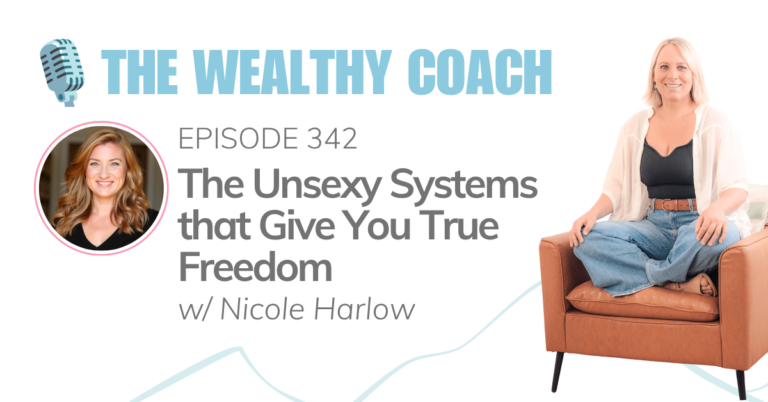
Every coach dreams of having more freedom in their business, but most are buried in repetitive tasks that quietly steal hours every week. The problem isn’t that you need to work harder. It’s that your business needs better systems.
In this episode, Kendra sits down with automation expert Nicole Harlow to unpack the behind-the-scenes systems that help business owners reclaim their time without sacrificing the client experience. They discuss where AI actually belongs in your business, the biggest automation mistakes coaches make, and why creating intentional client journeys can improve both efficiency and connection.
Whether you’re still doing everything manually or you’re ready to streamline your operations, this conversation will help you identify the bottlenecks that are keeping you stuck and show you how simple systems can create more freedom, consistency, and room to grow.
Listen to the podcast here
Listen on your preferred podcast platform:


In This Episode:
- The “red Ferrari with no engine” mistake almost every coach makes when they build their business
- How to tell if your plateau is a marketing problem or a backend problem (most people guess wrong)
- The one simple automation sitting in your CRM that could be quietly making you thousands
- Why hiring a VA before you do THIS just transfers your chaos to someone else
- What 7 AI employees actually do in Nicole’s business right now 🤖
About Nicole Harlow:
Nicole Harlow spent years watching brilliant health practitioners hit the same invisible wall: their offer worked, their clients got results, their marketing was solid — and yet scaling felt impossibly heavy. The problem wasn’t strategy. It was infrastructure.
Today, as the founder of Lead Better HQ, Nicole helps coaches, functional medicine practitioners, and wellness brands build the back-end systems that turn a chaotic practice into a business that actually runs.
Her work covers the unsexy but essential layer most coaches avoid: client onboarding, automated workflows, group program delivery, and the operational backbone that lets you stop being the bottleneck in your own business. She believes the next revenue ceiling for most practitioners isn’t a marketing problem — it’s an operations one — and she’s built her company to be the answer.
Connect with Nicole:
Instagram: https://www.instagram.com/brandbetterco/
Website: https://leadbetterhq.com/
Tech Stack Calculator: https://leadbetterhq.com/stack-calculator
Customer Journey Tool: https://leadbetterhq.com/challenge
Leave the podcast a 5-star review: https://ratethispodcast.com/wealthy
Why You Can’t Scale Your Coaching Business Without Systems (Even If You Hate the Backend)
Let’s be real for a second. When you think about growing your coaching business, where does your brain go? Probably to the fun stuff. New branding. A fresh website. More social media content. Maybe a flashy launch. What almost nobody gets excited about is the unsexy backend work, the systems and operations that actually keep the whole thing running.
But here’s the truth that took me years to fully accept: you cannot scale without it. You can white knuckle your way to maybe 5k or 10k a month on hustle alone, but at some point you hit a ceiling. And no amount of extra marketing is going to break you through it.
In this episode of the Wealthy Coach Podcast, I sat down with Nicole from Lead Better HQ, who has spent 15 years building businesses for health practitioners and coaches. She runs three agencies covering branding, content, and operations, and she had so much gold to share about the part of your business you keep avoiding. We talked about why operations feel so overwhelming, how to know if a plateau is a marketing problem or a systems problem, and how AI agents are changing the game for solo business owners right now.
If you’ve ever felt stuck, overwhelmed, or like you’re working way too hard for the results you’re getting, this one is for you. Let’s get into it.
What Operations Actually Means (Front of House vs Back of House)
One of the reasons operations feels so intimidating is that nobody really defines it clearly. So Nicole gave us an analogy that finally made it click for me.
Think about a restaurant. The front of house is everything the customer sees. The branding, the décor, the menu, the vibe. In your business, that’s your brand, your website, your marketing, your social media. It’s the pretty stuff that people invest a lot of money into, and for good reason.
But the back of house is what actually makes the restaurant run. The kitchen, the prep, the systems behind the scenes. As Nicole put it, operations are all the parts people don’t see that are running in the background. For health practitioners, it’s literally their back office.
And operations covers more than you’d think. Onboarding sequences. Nurture and welcome emails. Lead follow up. Even social media posting can be considered an operational task, because you want people landing on your profile and seeing that you’re actually still in business.
Here’s the kicker. Most of this stuff is happening manually. Nicole calls her clients the “sticky note practitioners.” She told a story about a client who literally had a sticky note on her desk that said “check Google voice,” because she had to remind herself to check her own business phone number. If that hits a little close to home, you’re not alone.
The whole goal of good operations is to take those manual, sticky note tasks and either streamline them or automate them so they’re not constantly sitting on your to-do list.
Why We Resist the Backend (And Why It’s Costing Us)
I asked Nicole something I’ve always wondered. Why do people have this wall, this resistance, toward the backend stuff? Because I see it all the time with my own clients. We have a whole section in my program about scaling, and the first part of scaling is really just optimizing your backend. But people skip right over it.
Her answer surprised me. She told me she is not a naturally organized person. At all. Even though she runs an operations and automations business, she resisted systems for over a decade because she thought they would box her in and take away her freedom.
That’s the mindset trap so many of us fall into. We think systems mean rigidity. We think they’re techie and boring and the opposite of the creative freedom we started our businesses to have.
But Nicole flipped this completely. For her, systems are now the reason she has freedom. When a lead comes in and gets responded to within two minutes without her touching it, that’s freedom. When she can be on a beach somewhere and leads are still getting booked onto calls, that’s freedom. A system equals freedom to travel, freedom to step away, freedom to not be chained to your inbox.
The problem is that branding is fun. Colors are fun, fonts are fun. So when you’re getting started, you gravitate to the sexy part. You build the logo, you build the website. And then you forget the engine.
Nicole’s metaphor for this is perfect. It’s like building a beautiful red Ferrari and forgetting to put the engine in it. Your brand and content are doing their job, bringing in clients, but things keep breaking because you never built the system underneath.
How to Tell If You’re Stuck on Marketing or Stuck on Systems
This was the question I was most excited to ask, because I see people plateau at very specific income brackets. Usually it’s right before six figures. People get stuck right at that threshold and can’t push through.
So how do you know if you just need to market more, or if it’s a backend problem holding you back?
Nicole’s answer was clear. People who can’t get past a certain income point are almost always still doing too many manual tasks. That’s where the lack of a system shows up.
She broke the diagnosis down into two questions:
- Do you actually have leads coming in? If you’ve hit a ceiling but nobody new is coming through the door, that’s when you look harder at marketing.
- Do you have the capacity to handle more? Look at your calendar. If you genuinely can’t take on another call or another client, marketing harder won’t help you.
And here’s the part that really landed. If you market harder without a system in place, people just fall through the cracks. Nicole fixes a lot of practices and clinics that hired marketing agencies, ran ads, and declared “it didn’t work.” But often the ads worked fine. The business just didn’t have the capacity to handle the leads that came in.
She also shared something vulnerable that I think a lot of us will recognize. For years she’d write on her wishlist that she wanted to grow, scale, hit six figures, hit a million. But at the same time she was psychically pushing those goals away, because deep down she knew she didn’t have room on her calendar to take it on. No amount of marketing fixes that. You have to look at your capacity and your systems first.
The Magic of Automations (And Why They Depersonalize Things in the Best Way)
This is where the conversation got really practical, because “build a system” can sound vague. So Nicole made it concrete.
One of the simplest, highest-leverage automations? A follow up sequence for when someone doesn’t show up, cancels, or says “not right now.” Think about how many people are sitting on your list right now that you talked to six months ago and never reactivated.
Here’s why we don’t follow up. We get in our feelings. Someone doesn’t show, and we tell ourselves they must not like us, or “screw them, they wasted my time.” But the truth is, life just happens. People ghost. We’ve all ghosted on something. Nicole’s point is that automations depersonalize this in the best possible way. A quick tag in your CRM that triggers a “hey, we missed you, let’s get back on a call” email takes the emotion completely out of it.
And follow up is just the start. Nicole walked through automations across the entire client journey:
- A welcome and nurture sequence when someone joins your list
- A check in when a coaching client hasn’t filled out their workbook or food journal in a few weeks
- A referral or review request tied to a milestone, like when a client just hit a big win
That last one is huge. So many of us wait until the very end of a program to ask for a review or referral, and by then the client may have petered out. But if you tag a client right when they’re at their peak result, the system asks for the referral at the perfect moment, automatically.
The bigger principle here is that systems supercharge everything else you’re doing. If you’re pouring time into ads, social posts, or emails to your list and you don’t have a basic system moving people along their journey, you’re leaving money on the table and doing extra work on top of it.
AI Agents and AI Employees: What’s Actually Possible Right Now
I really wanted to dig into AI agents, because it’s an area I’m still learning about myself. With how expensive it is to hire people, how much can an AI agent actually do? Nicole had a lot to share here, with some smart caveats.
First, the caveat. For her healthcare clients, HIPAA compliance is a real issue, so there’s a limit to what an agent can do with patient health data right now. Her team is building a HIPAA compliant patient facing chatbot, but as she noted, this space moves so fast that the landscape may look totally different by the time you’re reading this.
Where she’s seen big wins is with voice agents and chatbots that handle the front of house. Picture a busy front desk where it takes 20 minutes to get a new patient’s info into the system. A voice agent can answer basic questions, sound genuinely human (with upfront disclosure that it’s a virtual assistant), and get people to the right next step. Where’s your location? How do I get my labs? What’s your fax number? It runs 24/7, so someone can call at two in the morning and still book a discovery call.
Nicole described AI agents as the modern version of the greeter at a restaurant. They tell you the wait time, get your name down, and point you in the right direction. Your website used to be your front of house person, but it wasn’t interactive. Now AI agents can play that role.
Then there’s the next level she’s personally moving into: AI employees. She has seven of them working in the background of Lead Better, all built through the Claude API and Claude Cowork. And her take was striking. She said they’ve shown up more effectively than any human she’s ever worked with for certain tasks, especially recall. She can ask “where am I at with Susie who came in three weeks ago?” and instantly get the full history and next step.
Where AI employees shine is project management, quality control, and virtual assistant work. The stuff that involves following instructions, remembering details, and cleaning up behind a busy founder. As Nicole pointed out, this is also where a lot of people get disappointed by human VAs, because they hire a VA expecting a strategic right hand person, when a VA is really meant to follow orders, not make decisions.
She runs a hybrid now. AI employees handle project management and admin, while her human team builds the automations, tools, and content.
Don’t Lose the Human Touch
For all her enthusiasm about AI, Nicole was firm on one thing. Don’t automate so much that you strip the humanity out of your business.
We’ve all been stuck fighting with an AI agent when we just wanted to talk to a human. I told her how much I hate that, and how I’ll unsubscribe from a platform that makes me fight for a real person. She agreed, and said that as someone building these tools, knowing where that threshold is matters enormously. Your AI should be your best brand ambassador, not the thing that annoys people into calling a competitor.
Her advice is to be intentional about where you show up human to human. For Nicole, it’s social media. Her process is automated, but she follows clients, watches their stories, and engages with them like a real person. For you it might be a quick text, a Loom video, or a personal check in call. When you have a great system, you get to choose those human touch points instead of drowning in busywork.
One small example she loved: record a single onboarding Loom. “Hey, it’s Nicole, I’m so excited you’re here, this is what to expect.” It takes five minutes to record once, and every new client gets a face to face moment that an AI generated email can’t replicate. As we move into a more AI world, that human connection becomes more valuable, not less.
Three Things to Do Right Now to Get Started
Before we wrapped, I asked Nicole for the most actionable steps someone can take if they’re just starting to think about their systems, or feel a bottleneck coming. Here’s what she gave us.
First, and it’s the one nobody wants to do: map your client journey from start to finish. Give yourself 90 minutes, put on some music, grab a drink, and actually sit down and do it. Talk it through with Claude step by step if that helps. Start at the very beginning. Where do leads find you? What happens after a discovery call? What if they don’t show, cancel, or say not right now? How do they onboard? What does care look like as a client? And the part everyone forgets, what happens after, so they stay a paying client for as long as you can keep delivering results.
Second, once you’ve mapped everything out, do another pass and find where you feel the most resistance. Is it posting content? Following up with leads? Nicole admitted she was great at sales but bad at follow up, and lost so much money just by sending one follow up and stopping. A single extra follow up could have turned into a $20,000 client. Pick two or three of those resistance points and ask AI what you should put in place.
Third, treat AI like a real strategic partner, not just a content generator. Nicole trains Claude on who she is, her personality, her goals, even her astrology and human design, so it gives advice routed through her actual energy rather than generic guru advice. She’s an introvert who can’t white knuckle through a five day calendar of calls, so the standard “grind until you make it” playbook doesn’t work for her. When you tell AI your goals and how you actually like to work, it becomes shockingly good at filling in the gaps in a way that fits your life.
Ready to Build Systems That Actually Give You Freedom?
If this episode lit something up for you, that itch of “okay, I think it’s time I finally dealt with my backend,” then do not skip it. Nicole packed this conversation with practical, do-it-today advice, and she’s also sharing two free tools: her Stack Calculator to get a handle on how much you’re spending on tools every month, and her Patient Journey Mapper to walk healthcare business owners through mapping and automating their entire client journey.
Systems aren’t the boring thing standing between you and growth. They’re the engine that makes the growth possible, and the path to actually having the freedom you started your business for in the first place.
About Nicole Harlow
Nicole Harlow spent years watching brilliant health practitioners hit the same invisible wall: their offer worked, their clients got results, their marketing was solid — and yet scaling felt impossibly heavy. The problem wasn’t strategy. It was infrastructure.
Today, as the founder of Lead Better HQ, Nicole helps coaches, functional medicine practitioners, and wellness brands build the back-end systems that turn a chaotic practice into a business that actually runs.
Her work covers the unsexy but essential layer most coaches avoid: client onboarding, automated workflows, group program delivery, and the operational backbone that lets you stop being the bottleneck in your own business. She believes the next revenue ceiling for most practitioners isn’t a marketing problem — it’s an operations one — and she’s built her company to be the answer.
Connect with Nicole:
Instagram: https://www.instagram.com/brandbetterco/
Website: https://leadbetterhq.com/
Tech Stack Calculator: https://leadbetterhq.com/stack-calculator