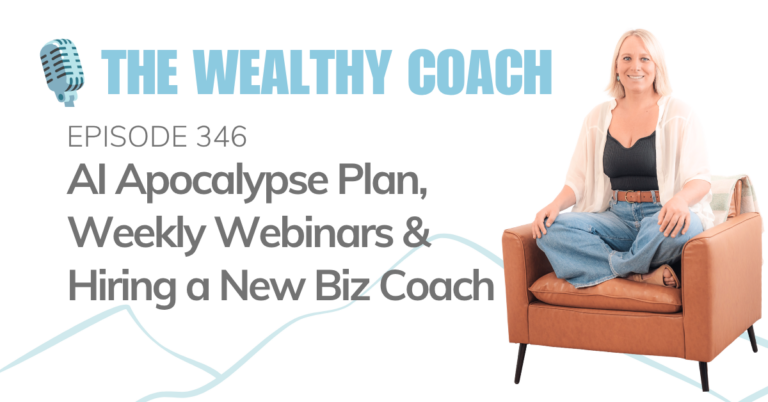
Kendra didn’t really have an agenda for this episode. She just wanted to talk about what she’s been working on, what’s changing in her business, and the things she’s been thinking about lately.
She gets into her new weekly/biweekly webinar strategy, why she’s moved away from relying on an automated webinar, and what she’s learning as she tests a brand-new webinar with cold traffic. She also shares why she finally decided to hire a business coach again after nearly two years without one, and what she’s hoping to get out of the investment.
Then things get a little more existential. Kendra talks about AI, why she doesn’t think human connection is going anywhere, and the slightly unhinged “AI apocalypse plan” she and her partner are cooking up in case AI eventually eats the internet. It’s a very Kendra episode: part business strategy, part behind-the-scenes, and part what the hell are we all going to do when AI takes over?
—
Listen to the podcast here
Listen on your preferred podcast platform:


In This Episode:
- What a bi-weekly webinar actually is, and why almost everyone gets the frequency thing wrong
- How my tech VA resets the entire funnel in 15 minutes while I’m live, so the ads never turn off
- Why I hired a coach after two years without one, and what it cost me to go without
- The very unsexy thing my partner and I are investing in as an AI apocalypse plan
RESOURCES:
Get FG Funnels: https://kendraperry.net/fgfunnels
Leave the podcast a 5-star review: https://ratethispodcast.com/wealthy
The Bi-Weekly Webinar Strategy: A Full Behind the Scenes Look at What I’m Building Right Now
I want to do something a little different today.
A few weeks back, right before I went to Spain, I recorded one of those no-agenda episodes where I just talked about whatever was on my mind. And the feedback was so good that I decided to do it again. So this is another one of those. No plan, no framework, just me telling you what I’ve actually been working on in my business, what’s been keeping me up at night, and what I’ve been thinking about.
The main thing I want to get into is the bi-weekly webinar strategy, because I’ve been alluding to it on social media and a lot of you have been asking me about it. What is it? How does it work? Isn’t that a lot of promoting? Am I really emailing my list every two weeks?
Short answer: no. And there’s a really important distinction that most people miss when they hear “bi-weekly webinar,” which is why I want to break the whole thing down here.
I’m also going to talk about why I completely rebuilt a webinar that was already making me money, why I hired a coach after going two years without one, what I think AI is actually going to do to the coaching industry, and the very unsexy thing my partner and I are investing in as an AI apocalypse plan.
Let’s get into it.
Why I Still Believe in Live Webinars (Especially Right Now)
If you’ve been listening to this podcast for any length of time, you know I’m a big fan of webinars. Specifically the live webinar.
For newbies, the live webinar is almost always the best place to start. Anything automated requires you to be really good. You have to nail your messaging. You have to nail your offer positioning. You have to be great at selling and you have to genuinely know what you’re doing. For the early stage coaches I tend to support, the ones who are a few months to a few years in and have never run a webinar before, going straight to evergreen is not the move.
But here’s the bigger thing I’m noticing, and I’m seeing it across multiple industries and in my own business too. Automated is just becoming a harder sell.
I’m not saying it’s impossible. There are absolutely people still crushing it with evergreen funnels. But people are skeptical now. They’re hesitant. They’ve had bad experiences. They’ve bought things that didn’t deliver. And I think because of AI, people are craving humanness more than ever. They want to know there’s an actual person on the other side of the screen.
The beautiful thing about a live webinar is that people are interacting with you in real time. They can ask questions. They can see you think. They can watch you be a person.
Live is also a fantastic way to test a webinar, because you get to see that live interaction and feel where the energy drops. And the numbers are just better. As soon as you go automated, your conversion is going to drop by at least half. If you’re converting 5% of live attendees, you might go down to 2% or even 1.5% on evergreen. Most people want the higher conversion, so why not stay live while you can?
How often should you actually run a webinar?
I usually have my students running a webinar every four to eight weeks. More frequently is generally better, but truthfully it comes down to how fast you’re growing your email list.
You cannot promote the same webinar to the same group of people over and over and over again and expect them to keep showing up. You need fresh leads coming onto your list every single month to promote that webinar to. That’s the constraint. Not your energy, not your calendar. Your lead flow.
Which brings me to the part that confused a lot of people.
What a Bi-Weekly Webinar Actually Is (And What It Isn’t)
When I started talking about doing a bi-weekly webinar, I got a lot of responses along the lines of “that’s a LOT.” People assumed I was emailing my list every two weeks begging them to come to the same training. And I understand why that sounds insane, because it would be.
So let me make a clear distinction.
If you are only promoting to your warm audience, meaning your email list, I probably wouldn’t run a webinar more often than every month. Otherwise you’re just hammering your people with promotion constantly. They get tired. They get sick of it. They tune out. To pull that off you’d need to be growing your list extremely fast.
The weekly or bi-weekly webinar is a cold traffic strategy. It’s an ad strategy.
My email list only gets invited to these every eight weeks. That’s it. In between, we’re using Meta ads to send cold traffic to the registration page and get people to opt in.
That’s the whole thing. And once you understand that, the frequency stops sounding aggressive and starts sounding smart.
Quick note on terminology, because I know people get tangled up in this. When I say bi-weekly, I mean every two weeks. Some people are running these weekly. I use weekly and bi-weekly somewhat interchangeably when I talk about this, because I’m really just describing a high-frequency webinar. I chose every two weeks because when I do a webinar, that’s my whole day. I do the webinar and then I have zero focus or motivation left. I’m done. Doing that every single week would be rough with my current schedule.
That said, I’m open to moving to weekly. We shall see.
The Setup: An Automated Strategy Minus the Webinar
Here’s the part I think is genuinely cool about this model.
It’s an automated strategy minus the webinar. The webinar is the only piece that happens live. Everything else runs in automation.
Here’s how it works:
- We have traffic driving to one ad that tells people to register
- That ad sends them to a registration page
- They sign up for the next event
- Right after I go live on Zoom, my tech VA Kim switches everything over
What Kim actually does during that 10 or 15 minute window while I’m live:
- Switches the date on the registration page
- Switches the tag so we know which webinar people are attending
- Resets the deadline
The key detail is that the ad itself has no mention of dates or times. The only place a date and time appears is on the registration page. So the ads just always run. They never stop. Once Kim flips everything over, anyone who lands on that page automatically gets the information for the next one, two weeks out.
That’s it. The ads never turn off, the campaign never has to be rebuilt, and the only live element is me showing up.
Why I made the switch
I was running a webinar every four to six weeks, and every time I ran one, I’d build a new ad campaign to drive traffic to it. The problem is that when you have to scale spend in a short time period, you pay more for the ad. Meta ads tend to be cheaper when you scale slower.
So every launch cycle looked like this: set up the ad campaign, scale it fast, pay a premium, invite my list, write and send registration emails, run the thing, tear it all down, and do it again a month later.
It was becoming a lot of work, especially on my end. So I thought, let’s just do this more frequently and make it less work overall.
And then, funny enough, right after I made that decision, I started seeing rumblings all over the entrepreneur world that this exact strategy was working really well for people. Especially after the last couple of years, which were hard on a lot of businesses. Mine included.
I’ve gone through a couple of years of floating. Not really growing. And I know a lot of business owners are seeing big revenue declines right now because of changing consumer behavior, changing purchase behavior, the cost of living crisis, and the AI revolution. So many things have shifted about how we do things online.
Seeing other entrepreneurs say this strategy was bringing revenue back into their businesses made me feel validated. It made me feel like this was the thing I should be doing.
The Webinar That Made Money and Was Still Wrong
Now here’s where it gets uncomfortable, because I have to admit something.
The webinar I’ve been running is everything you shouldn’t do in a webinar. It’s everything I teach people not to do in a webinar.
Let me back up.
For about three years I had an evergreen automated webinar selling HTMA Expert that sold like gangbusters. It was consistent. It brought in sales month after month after month. I barely touched it. I didn’t change the emails. I didn’t change the webinar. I think in three years I only ran maybe three different ad campaigns for it. It was a golden egg.
And then it just stopped converting. This was early 2025, right when there were big shifts in the market and in how people were buying.
The infuriating part was that all the numbers looked good:
- Registration rate was good
- Retention was good, people were staying to the end
- Click-through rates were high
- Open rates were really high
- People were going to the sales page
We had tons of good data. Something just wasn’t connecting.
And at the time, I was about a year postpartum. If you’ve had a kid, you know it takes your brain a while to come back online. I was staring at this thing going “I cannot figure this out.” I tinkered with it for months while revenue dropped, and eventually I said fine, back burner. Let’s do something live, because I know I can sell live.
But I didn’t want to use that same webinar, because clearly something about it wasn’t working. And I also didn’t have the bandwidth or the time to create a brand new one.
So I went into the archives and dug up a webinar I’d run back in 2019.
It was all teaching. Straight introduction to hair tissue mineral analysis with a pitch at the end. But I’d run it maybe three times and it had generated somewhere between $30,000 and $50,000 each time. So I figured, why not throw it out there? I was in my era of breaking the marketing rules.
I put it out in June 2025 and it did $40,000 to $50,000. Cool. Let’s do it again. I’ve now run it eight more times and almost all of them went well. There was one in March that underperformed, but March is historically a dip month for me.
Why teaching on a webinar is a trap
Here’s the thing though. If you don’t understand the psychology behind webinars, the single worst thing you can do on one is teach.
When you teach, two things happen:
- You overwhelm people with more than they can hold
- You give them a small piece of a much bigger puzzle and make them believe they can go figure the rest out alone, which they genuinely can’t
What you actually want to do on a webinar is create a gap. A gap between the knowledge you’re showing them and your program.
You want them walking away thinking “this was really good information, I see things more clearly now, and I can also see how much easier this would be with someone supporting me.”
You don’t want them feeling totally dependent on you. If people believe they’ll fail without you, that feels defeating and they shut down. You want to give them a belief shift. An aha moment where they think “oh my God, I see this differently now, and it’s actually simpler than I thought.” And then you show them that yes, it’s simpler than they thought, and they’ll still do better with support.
My 2019 webinar did none of this. Zero gap creation.
So it converted, but the conversion was low. And I made up for that low conversion with traffic. I’m really good at running my own ads and I can get myself a very cheap cost per lead. Because HTMA Expert is mid-ticket, it didn’t matter that I was spending a lot on ads, because the ROI was there.
I was covering a structural problem with volume.
That works until it doesn’t. And I knew the second I switched to a bi-weekly model where seven out of eight webinars go to cold traffic only, people who don’t know me and don’t trust me, that format was going to fall apart. Warm audiences forgive a weak webinar. Cold traffic does not.
I needed a new webinar.
Why I Hired a Coach After Two Years Without One
Here’s my honest confession about webinars: I’m very good at looking at other people’s webinars and finding the gaps. I’m great at helping other people build theirs.
Building my own is a nightmare.
A webinar is one of the hardest things an entrepreneur will ever build. You have a very short window to get your point across, there’s a lot of sales psychology baked into it, and most of us have way too much to say. Myself included.
I always do better on my own webinar when I’m working with a coach, because I fall into the exact same traps my students do. When I’m not emotionally involved, it’s easy. I’m working with a client right now who helps newlyweds with PCOS address infertility. I don’t know much about PCOS. I don’t know much about infertility. And that’s exactly why I can map her webinar out so easily. I’m objective. I’m not tangled up in it.
Around the same time I realized I needed to revamp this webinar, my brain came back online. It’s not that my brain wasn’t working before. I just didn’t have the bandwidth to focus on growing. I was fine coasting. Revenue was down from where it had been, but I was doing near a million annually before I had my little guy, and even after the dip it was still more money than I need. So I coasted. I plateaued. I was okay with it.
And then I finally felt that motivation again. That itch for growth. That’s when I knew I was ready for a coach.
Finding the right coach is hard
Finding a coach is a hard thing, as you probably know. You might be vetting a coach right now. You might be listening to this episode looking at me and wondering if I’m the person who could help you. You want to make sure you make the right choice and feel full confidence that someone can actually help you.
At my level, that gets harder. I’m not saying I know everything. There are so many entrepreneurs who are way smarter than me. But this isn’t my first rodeo. I’ve been in business 13 years, so I need the right person.
I knew I needed personalized one-on-one support. I’d been in a mastermind before, but the support was very group focused and I got lost in it. I didn’t get the personalized eyes on my whole business that I needed. And ultimately that mastermind pushed me in a direction I didn’t want to go. When I got out, I realized that wasn’t the business model I wanted at all.
I also knew what it was going to cost. When you buy coaching at my level, you pay. I knew I was looking at a five figure investment. Not $5,000. Not $10,000. Somewhere in the $15,000 to $25,000 range. And I was fine with that. I just wanted the right person.
So I was cruising around, looking at different people, and I came across Julie Chenell.
Julie owns Funnel Gorgeous and FG Funnels. I’ve been using FG Funnels since 2021 and in my opinion it’s the best marketing software you can have. It’s an all-in-one platform and you can do pretty much everything you need inside it. All my students use it and their support is genuinely great.
I’ve actually known about Julie since 2018. I bought a bunch of her courses and learned so much from her. I always thought her stuff was the best. I knew she had a private one-on-one coaching mastermind and there was even a point where I considered it, but I went with the other group-focused mastermind instead. Then she drifted off my radar for years.
Then I started seeing her posts on Threads. I thought, oh yeah, Julie. I really like Julie. So I started following along again, subscribed to her podcast, started consuming her stuff. And it clicked fast. Julie is the boss. This is my coach.
What I didn’t know was that she was getting absolutely hammered with client inquiries at that exact moment.
If you’re not familiar with Jessie Jean, she’s the creator of the Yap Challenge and she had a viral launch. No ads, just a few emails, and I believe she generated 1.7 million on the first one and around 3 million on the next. I might have the numbers slightly off, but it was wild. She grew an Instagram account to 500,000 followers in about five months and then launched a $300 challenge and made millions.
Jessie works with Julie. She’s in the program. And Jessie had given Julie a public shout out, talking about the things that helped her succeed and mentioning that Julie wrote the emails for that launch.
So with a 500,000 person audience hearing that, people were flocking to Julie.
I was reaching out in the middle of all of this, completely unaware. I didn’t even really know who Jessie Jean was at that point. I put in my application, got an email back, and could see she was full and possibly building a waitlist. I thought I’d missed my chance.
Luckily I got on the phone with her and she opened one final spot for me. I’m now in her program, Digital Insiders Club, and I’m ecstatic.
I always do better with a coach. It was actually strange for me to go two years without one. If I’d had a coach through that stretch, I probably would have maintained my almost seven figure year and probably would have hit seven figures. But I wasn’t in the headspace. I was on mat leave for four months, then came back very part time, and I didn’t have the time or bandwidth to do the things growth requires.
Going Into a Launch Completely Blind
So here’s where I actually stand right now.
I’ve done one bi-weekly webinar so far, but I ran it with the old 2019 teaching script and about half organic traffic. I invited my whole list. It went very well. We generated 13 or 14 sales into HTMA Expert plus about six down sells.
By the time this episode drops, I’ll have done the second one. And that second one is a completely different animal:
- Entirely new script
- Entirely new slide design
- Entirely new bonuses
- Entirely new strategy
- All cold traffic, no warm email list
- A brand new ads account
That last one is the extra confounding factor. Starting around February my Facebook ads account started falling apart. Ad costs went up significantly, I was getting errors, weird things kept happening. It got so corrupted it was unusable, and of course support couldn’t help me. So I started fresh in the middle of June. A new ad account has to learn, and it’s still in that learning phase, so I’m not fully confident it’s bringing me the right traffic yet.
Which means I’m going into this webinar 100% blind.
I genuinely can’t remember the last time this happened. Probably the first three years of my business. Normally I’m promoting to a warm audience I’ve nurtured, so even on a first-time training I know I’ll make sales. Or I’ve run something so many times I know exactly how it converts. That old teaching webinar was the ninth time I’d run it. I always converted in the same window, so I always knew roughly how many sales I’d make based on registrations.
Now I have a new webinar, cold traffic only, new bonuses, new everything, and a new ad account. It honestly feels like the first day of school. I’m nervous.
The mindset that makes this survivable
This part matters a lot if you’re about to run your first webinar.
You have to curb your expectations. That first one is 100% a test. Full stop.
I’m going in with no expectations. I’m committed to running this bi-weekly webinar for at least a year, probably longer, so I’m in it for the long haul. I’m not going to hit the first one out of the park and I know that. If I break even on ad spend, we’ll call that a win. If I don’t, that’s okay too.
It is a test. I’ll see how it goes, and then I’ll adjust. And I have a great coach in my back pocket to help me figure out what needs to be tweaked.
That’s the whole game with webinars. Reps, data, adjustments. Not perfection on attempt one.
The Yap Challenge and Getting Better on Camera
The other thing I’ve been deep in for the past several weeks is the Yap Challenge.
I know, I know. Everyone is talking about the Yap Challenge. But I’m going to talk about it anyway, because I found Jessie through working with Julie and I signed up purely out of curiosity. It’s $297. It’s nothing. I just wanted to know what everyone was going on about.
Here’s my honest read on myself: I do a lot of talking head reels and I think I’m a pretty great speaker. I also have a lot to learn, because we always have a lot to learn. And clearly I did not grow my account to 500,000 followers by talking to a camera. So there’s something Jessie is doing that I am not doing.
I love the program. I’d recommend it to anyone who wants to make better videos on social media. You get daily prompts, the prompts are great, and I’m making types of videos I never would have made otherwise. I’m seeing good traction with them and getting a lot of response.
Honestly, I’m just enjoying it. It’s fun to practice speaking and to make something a little different than what I’ve been doing for years.
If you want to see the talking head reels I’ve been making, come find me on Instagram at @kendraperryinc. Give me a thumbs up, leave a comment, shoot me a DM and tell me if any of them land for you.
What I Actually Think AI Will Do to Coaching
Now for the thing I haven’t talked about publicly yet.
I’ve been thinking so much about AI. This AI thing is a complete mind fuck, for lack of better terminology. It’s really hard to understand where it’s going and how it’s going to impact us.
I recorded a reel last week about how I think there are aspects of health coaching that AI is going to replace. And I think it already has, when it comes to information.
If your coaching program, the way you work with people, or what you sell is built solely around giving people information, you’re in trouble. AI gives information easily, instantly, and for free. That information isn’t valuable anymore.
But I have a hard time believing there’s a future where we only work with AI and nobody wants to be in coaching programs with humans.
We actually ran a small experiment on this already. Remember COVID? We couldn’t see people in person, so we all decided Zoom hangouts were the answer. Five or six friends on a call with our little cocktails. We thought it would be great.
It sucked. It fucking sucked. I heard the same from everyone. People talking over each other, things glitching, and it was just not the same. Hanging out with a human on a screen and hanging out with a human in real life are not the same thing. We figured that out fast, and there’s been a huge resurgence in demand for in-person events ever since.
I also don’t think information is the only reason people buy coaching. And I don’t even think it’s only about the result.
Say you’re a coach helping women in perimenopause with sleep issues. They come to you to get rid of their insomnia, sure. But that’s not the only reason they join. They join because they want support. They want someone who has their back and actually cares about them.
I could technically use AI to get some version of what I get from Julie. I know it wouldn’t be as good. AI is not a great business coach. The people I see using AI as their business coach are typically not doing great, because you need enough knowledge to recognize when it’s giving you bad advice. AI gives you the average.
But beyond quality, it’s the knowing. Knowing Julie is in my back pocket. Knowing she’s going to be there, help me get traction, and support me. It feels different. It’s connection. It’s someone who has my best interest at heart, who cares about my success, and who I can bounce ideas off of.
It hits differently.
Maybe I’m being overly optimistic. This is purely my opinion and I could be completely wrong. I’m sure some people will say they hate humans and just want to talk to a robot, and cool, go for it. But personally I can’t see that ever being fulfilling.
My AI Apocalypse Plan
That said, I’ve been thinking hard about my AI apocalypse plan. Because I don’t know what’s going to happen. Maybe AI does take my job. I have no idea.
So I want a backup. I want to invest in something that’s AI proof.
My partner and I brainstormed a bunch of ideas. A storage unit facility. A car wash. And where we’ve landed is real estate development.
Here’s the context. There’s a massive housing crisis in Canada, and it’s especially bad in my community because there isn’t much land to build on. We live in the mountains. It’s not open and flat. Housing has always been in high demand here since the day I moved here, because where I live is genuinely beautiful and people want to be here. There just isn’t enough of it.
One thing that’s become popular around here is tiny pad communities. I had a friend, who unfortunately is no longer with us, who bought a piece of land, put down pads, and let people park their tiny homes or RVs on them. He provided sewage, water, and power. That’s it. He did really well and essentially retired himself off it in just a few short years.
That’s what we’ve decided to do. Right now we’re looking for the right land, and the plan is to build one of these communities, and possibly several across different properties.
What I love about the model:
- We provide power, water, and sewage; they provide the home
- If something breaks in their home, that’s their problem, not ours
- It’s relatively passive, and we can hire a manager or handyman
- The build cost is high up front, but ongoing management and expense are low
We’re already doing a small version of this. I have another property down the road that we developed and serviced. It’s build-ready. Some friends park their RV on it in the summer, not in winter because the snow here would make it unsafe, and they pay us monthly rent for the services. It’s one space, so it’s not a ton of money, but the management is almost nothing. We collect the rent.
And realistically, when something goes wrong on a property with those three services, it’s rarely power and rarely water. We’re on a community watershed, so water isn’t even really our problem. It’s sewage. In seven years in my own house we’ve never had a power or water issue, but yeah, we’ve called the plumber a few times.
I also like it as a retirement plan. I’d love to retire in my fifties. I don’t know if I could ever fully retire, because I’d need a project. I’d need something to tinker with. But having something relatively passive running in the background sounds pretty good.
If you’re doing well in your business and making money, reinvesting profit back into the business is great. Yes. But it might be worth thinking about something you can invest in that’s AI proof, just to set yourself up. None of us know how this is going to shake out.
Come Tell Me Your Plan
That’s the behind the scenes. The bi-weekly webinar and why it’s a cold traffic play. The webinar I had to tear down and rebuild. The coach I hired after two years of coasting. What I think AI can and can’t touch in this industry. And the tiny pad community my partner and I are about to build.
If you want to hear more about the bi-weekly webinar setup, DM me on Instagram at @kendraperryinc and just tell me you want more. I can absolutely go deeper on it.
And I’d love to know your AI apocalypse plan. Reach out and tell me what you’re thinking about, because I’m genuinely curious what other business owners are doing to hedge.
If you got something out of this, let me know if you want me to record an episode like this every four to six weeks. Just me telling you what I’m working on, what’s happening behind the scenes, and whatever else flies out of left field.